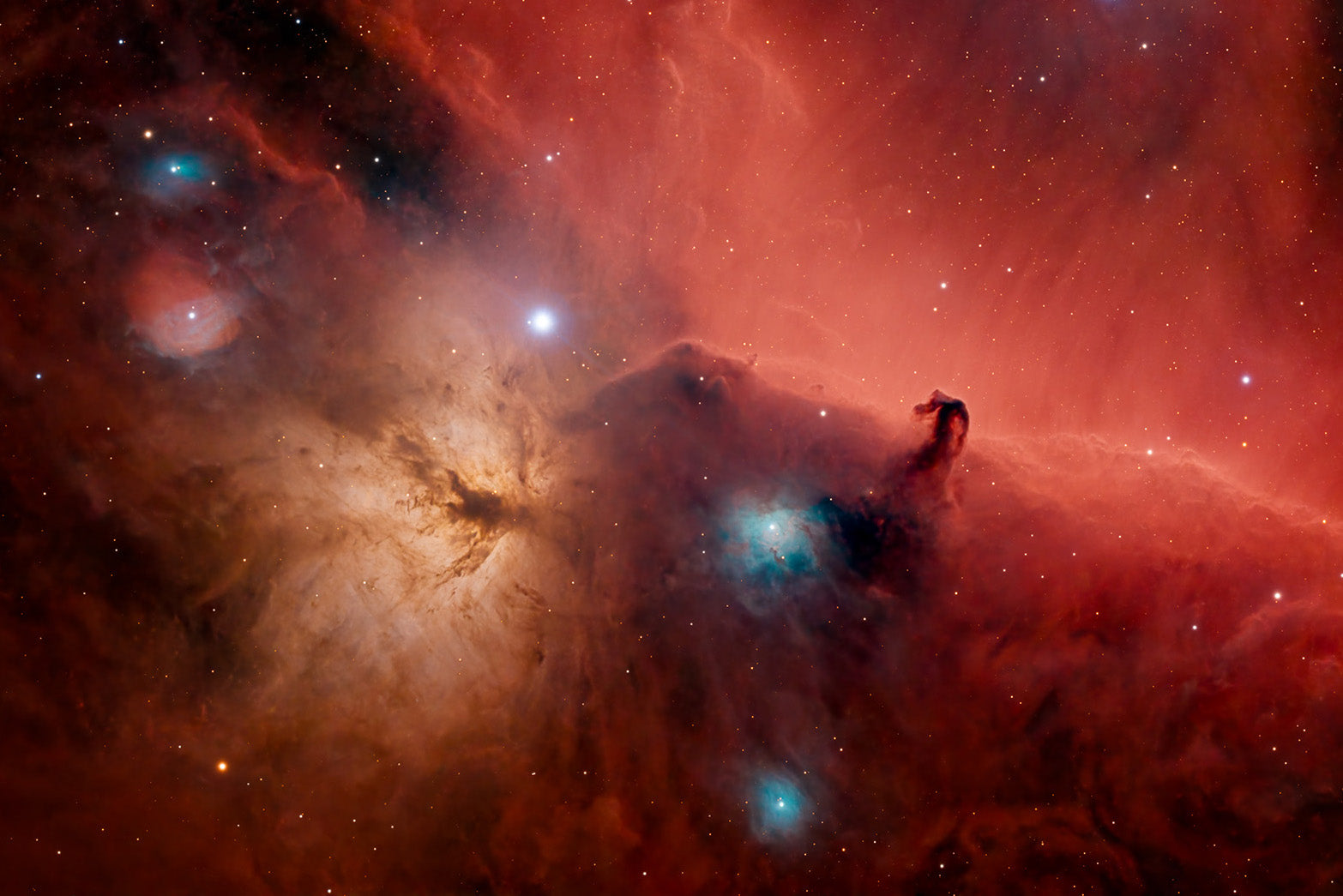
The Iconic Darkness: Why the Horsehead Nebula Belongs on Your Wall
There is a darkness shaped like a horse, 1,500 light-years away, that humans have been drawing toward for over a century.

The Horsehead Nebula — catalogued as Barnard 33, framed by the emission nebula IC 434 — sits just below Alnitak, the leftmost star of Orion's belt. It was first recorded on a photographic plate in 1888, by Williamina Fleming at the Harvard Observatory. She didn't name it. She simply noted it in a margin: a semicircular indentation 5 minutes in diameter. The name came later, from everyone who looked at the image and saw the same thing.
That's unusual in astronomy. Most deep-sky objects require imagination — a stretch, a suggestion, a learned pattern. The Horsehead requires nothing. You look at it and you see it. That kind of immediacy is rare in a universe that mostly deals in abstraction. It's precisely this graphic power that makes it such a compelling subject for astrophotography wall art.
What You're Actually Looking At: The Science Behind the Silhouette
The horse shape is not a structure. It's an absence. A dense pillar of cold gas and dust — a molecular cloud — rises in front of the glowing curtain of IC 434, blocking the light behind it. What you see as a silhouette is matter that hasn't yet become stars. Inside that darkness, under pressures we can't directly observe, stellar nurseries are forming. 
The reddish glow surrounding it is ionized hydrogen — the same emission that makes nebulae visible to long-exposure cameras, and invisible to the naked eye. That red is not a false color. It's the actual wavelength hydrogen emits when energized by nearby radiation. What astrophotography captures here is the real light. The camera just has more patience than the eye.
Why the Horsehead Nebula Makes the Perfect Fine Art Print
Some deep-space objects photograph beautifully but hang awkwardly as home decor. The Horsehead is the opposite. The composition is innate:
-
The dark shape grounds the image.
-
The gradient of the emission field provides deep, atmospheric contrast.
-
The bright star Sigma Orionis offers a natural focal counterpoint.
You don't need to frame it carefully; the image frames itself.
At large format, the molecular pillar reveals a texture that smaller reproductions lose entirely: subtle variations in density, a gradation from near-black to deep amber at the edges, and the faint wisps of material trailing behind the main column. These are details that only truly exist at print scale.
Hahnemühle Fine Art Baryta vs. Aluminum Dibond: Choosing Your Substrate
The image works beautifully on both substrates, but it tells two different stories:
-
On Hahnemühle Fine Art Baryta: The paper tone pulls the emission reds into something almost amber — closer to an analog darkroom print, closer to a photograph in the traditional sense.

-
On Aluminum Dibond: The same image becomes cooler, more contemporary. The blacks run deeper and the silhouette feels incredibly sharp. Two distinct readings of the same cosmic subject.

The Technical Challenge: What Makes It Difficult to Print
The Horsehead Nebula is a masterclass in contrast management. The darkest regions — the pillar itself — must hold shadow detail without collapsing to pure black. The brightest zones of the emission field must stay separated from clipping. And the transition between them, a narrow band of material at the edge of the silhouette, is where the print either holds or loses its structure.
This is where custom ICC profile work and substrate selection matter as much as the original astrophotography data. A profile calibrated for a specific paper stock renders that edge differently than a generic export.
The Printmaker's Choice: The Hahnemühle profile preserves a slight warmth in that transition; the Dibond profile keeps it neutral and sharp. Neither is wrong. They're simply different artistic choices about the same celestial subject.
Bring the Deep Sky into Your Space
The Horsehead Nebula has been photographed tens of thousands of times. It appears in textbooks, on screensavers, as the default background of astronomy software. None of that diminishes what happens when you see it at 80 × 60 cm on a wall, in the right light, with the shadow detail perfectly intact.
Some images are made for screens. This one was always meant to be printed.
Our premium Horsehead Nebula Fine Art Print is now available in our Astrophotography Collection. Choose between the timeless texture of Hahnemühle Fine Art Baryta or the sleek, modern finish of Aluminum Dibond — both available as open editions.
Explore the Print Options and Sizes.