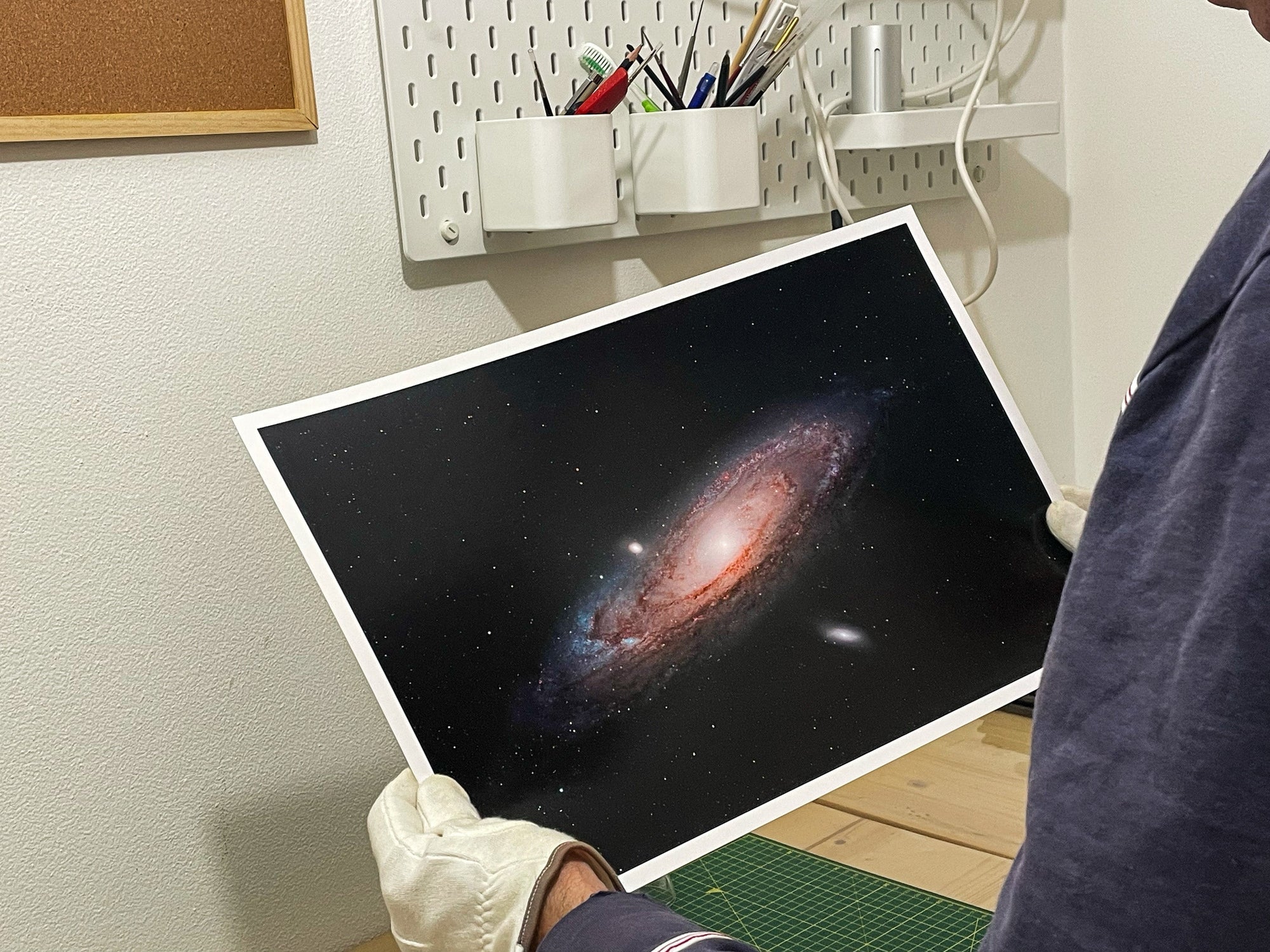
M31 was the reason I bought the telescope.
Not a nebula, not a cluster — the Andromeda Galaxy. The idea that with an amateur instrument, from my garden, I could photograph something that doesn't even belong to our galaxy seemed both impossible and necessary. Two and a half million light years. Light that left when nothing remotely human existed on Earth, landing on a sensor in my garden on an October night.
That first image was bad. Blurry, noisy, badly processed. But it was there. I started over.

In recent years astrophotography has exploded. Forums, groups, Instagram, APOD — hundreds of deep-sky images shared, commented on, appreciated every day. Smart telescopes have accelerated this: accessible instruments that in a few minutes produce an already-processed image, ready to share. They make sense — they lower the barrier to entry, bring people closer to the night sky. But they're born on the screen and they end on the screen. That's their natural ecosystem.
Not a judgement. Just an observation.
The problem is that screens lie — not out of malice, but by nature.
A screen emits light. It has a dynamic range no physical surface can replicate, and it rewards whoever works with those parameters: pushed contrasts, saturated colors, deep blacks obtained by crushing the shadows. On a phone in someone's hand while they scroll, that image works. It stops the thumb.
Most astrophotographs are born this way, live this way, and end this way — seen, appreciated, forgotten, replaced by the next one in the feed. That's not a flaw. It's the nature of the medium.
Then one day I decided to print M31.
When the print came out of the printer I let it dry. Then I picked it up with cotton gloves — to avoid leaving fingerprints on the surface — and laid it on the table under the artificial light of my studio. Then moved it toward the ambient light to see the colors and gradations as they really are.

There was a moment — a few seconds, maybe less — when I understood that on the monitor I had never actually seen that image. I had seen a representation of it, filtered through a device that emits its own light. On paper it was different. More real. The details of the galactic disk that looked fine on the monitor were something else entirely on paper — stable, deep, present.
Those photons that left 2.5 million years ago had stopped travelling.
They had become matter. Ink on fiber. Something you can hold in your hands — with gloves, out of respect.
This is the difference nobody explains to you until you see it.
An image on a screen is in transit. It loads, scrolls, disappears. Even the most beautiful one, even the one that got thousands of likes — it lasts the length of a scroll. That's not a flaw, it's the nature of the medium: it's a flow, not a permanence.
A physical print stops. It takes up real space, has weight, changes with the light in the room. That galaxy you photographed night after night, patiently, through mistakes, starting over — on paper it has a presence the monitor can't give you.
This isn't nostalgia for analog. It's not snobbery toward people who share their images online — I do it too. It's that they are two different experiences, and conflating them means giving one of them up.

M31 is still hanging in the studio.
Sometimes I walk past without even looking at it — it's part of the furniture now. Then occasionally I stop, and I remember that thing on the wall is real light. Not pixels, not bits. Light that travelled 2.5 million years and ended up on a sheet of paper in my studio in the Euganean Hills.
Could be worse.