There’s a smell you never forget. It’s the fixer — slightly sharp, hanging in the still air of the darkroom. Red lights, trays in a row, and a sheet of paper floating in the water, slowly — slowly — becoming an image.

That’s how I learned photography. Black and white film, Ilford Delta, D-76 developer, fiber-based paper under the enlarger. Every print was a physical gesture: exposing by hand, masking, dodging and burning with a piece of cut cardboard. No Ctrl+Z. Just time, concentration, and paper that either responded or didn’t.
Then digital arrived, as it did for everyone. Photography became faster, more immediate, more shareable. Better? In some ways, yes. But something was lost — that physical relationship with the image, that moment when the print emerges and you decide whether it’s right or whether you start again.
The telescope arrived three years ago.
An October night with a clear sky, the mount pointing east, and for my first target I chose M31 — the Andromeda Galaxy. Light that had traveled 2.5 million years, leaving when nothing remotely human existed on Earth, landing on my sensor that night, in that garden. 
The result was bad. Blurry, noisy, badly processed. But inside it there was something I had never seen in any of my previous photographs.
I started over.
The thing nobody tells you when you start astrophotography is this: it’s not a fast discipline. A decent image of a nebula takes hours of exposure, spread across multiple nights, with a mount that has to track Earth’s rotation to within a few arcseconds. Then there’s the processing — frame calibration, stacking, stretching, color curves — which can take as long as the acquisition itself.
And there’s no one to hold your hand. Or at least, I never found anyone. I learned alone, through articles, videos, forums, and above all through mistakes. Every problem solved opened two new ones. The method, in the end, was only one: try, fail, understand why, try again. Slow, sometimes frustrating, but the only thing that actually works.
It’s the same patience as the darkroom. Different in form, identical in substance. And at the end of the process, when the image is ready, the same thing happens as it did back then: you look at it and decide whether it’s right.
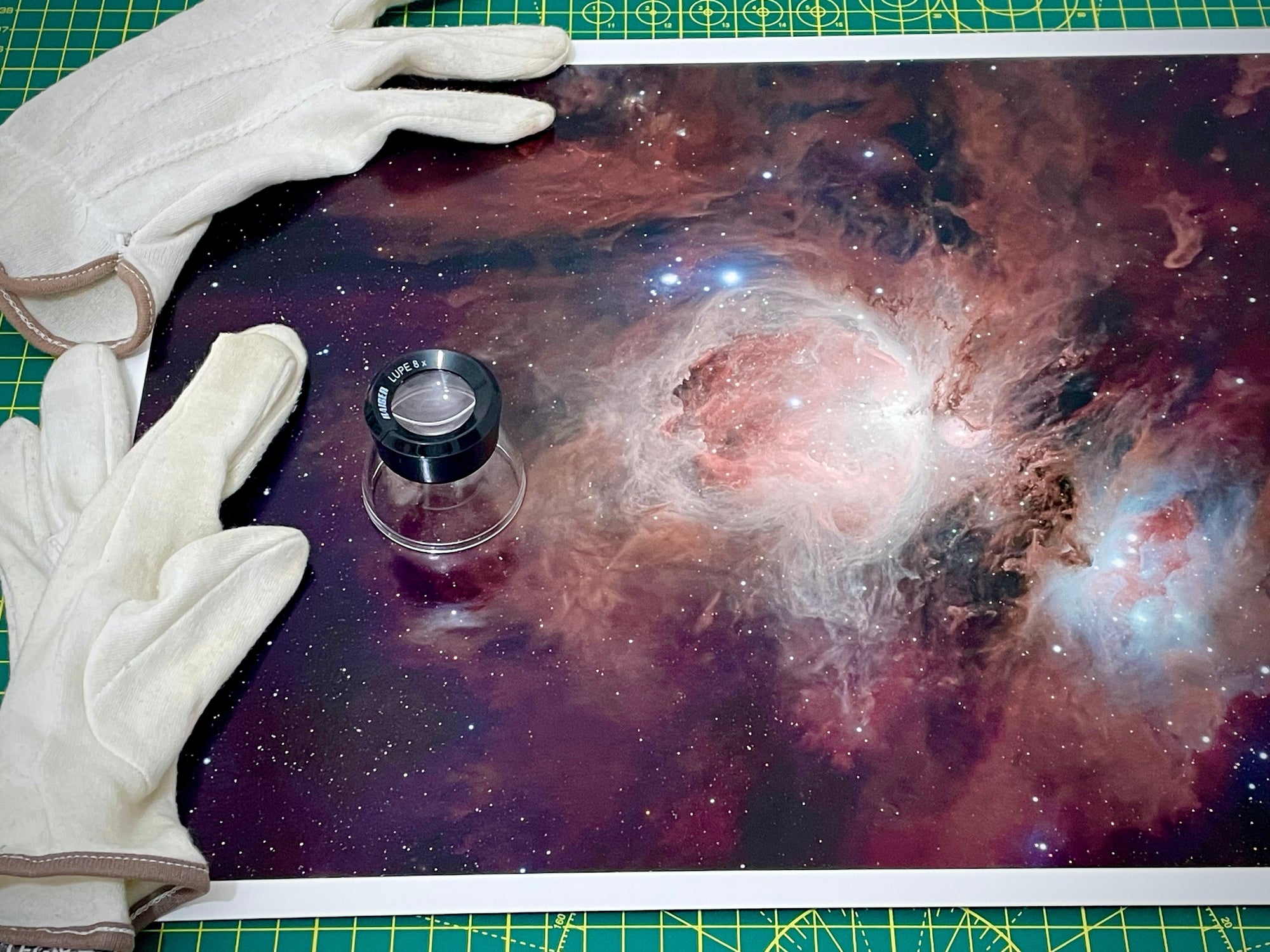
At some point I started printing my astrophotographs.
It wasn’t obvious. The monitor does everything — it has a dynamic range paper can’t replicate, backlighting, impossible contrasts. An astrophotograph on screen can be spectacular. But there’s a difference I only understood by seeing it: scrolling an image on Instagram and seeing it printed 70 centimeters on your wall are two different experiences. Not one better than the other — just different, like different genres.
Print forces choices. You can’t hide behind the brightness of a screen. Black has to be black because the paper decides, not because the pixel says so. And when those choices work, they give the image something a monitor doesn’t have: weight, presence, permanence.
I found the darkroom tray again. Changed in form — now it’s an inkjet printer on fine art paper — but identical in logic: light becoming matter.

That’s what this blog will be about.
Not astronomy in the academic sense, not equipment reviews, not step-by-step tutorials. I’ll write about what happens in the field — the nights that go wrong, the images that don’t come out as planned, the processing choices that change everything, and the moment when you decide an image deserves to exist on paper and not just on a screen.
From one enthusiast, to others.